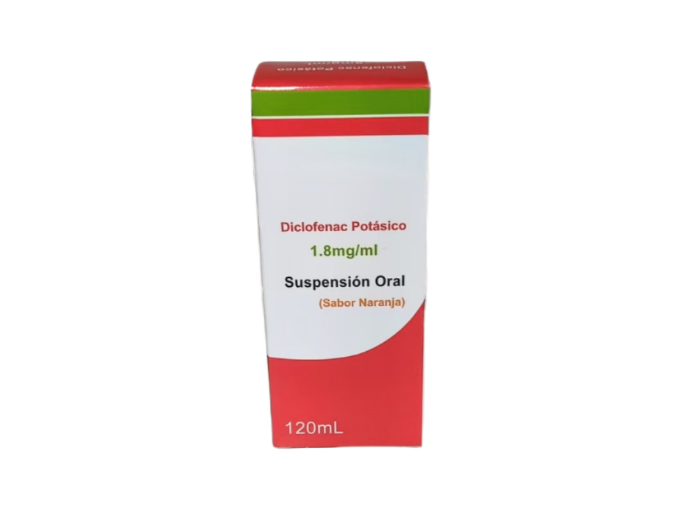
Diclofenac potassium for oral suspension is a nonsteroidal anti-inflammatory drug, available as a buffered soluble powder, designed to be mixed with water prior to oral administration. Diclofenac potassium for oral suspension is a white to off-white, buffered, flavored powder for oral solution packaged in individual unit dose packets.
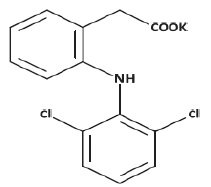
The chemical name is potassium [o-(2,6-dichloroanilino) phenyl] acetate. The molecular weight is 334.24 g/mole. Its molecular formula is C 14H 10Cl 2NKO 2, and it has the following structure.
The inactive ingredients in diclofenac potassium for oral suspension include: flavoring agent (peppermint), glyceryl behenate, mannitol, sucralose and tribasic sodium phosphate anhydrous.
Diclofenac potassium has analgesic, anti-inflammatory, and antipyretic properties.
The mechanism of action of diclofenac potassium, like that of other NSAIDs, is not completely understood but involves inhibition of cyclooxygenase (COX-1 and COX-2).
Diclofenac is a potent inhibitor of prostaglandin synthesis in vitro. Diclofenac concentrations reached during therapy have produced in vivoeffects. Prostaglandins sensitize afferent nerves and potentiate the action of bradykinin in inducing pain in animal models. Prostaglandins are mediators of inflammation. Because diclofenac is an inhibitor of prostaglandin synthesis, its mode of action may be due to a decrease of prostaglandins in peripheral tissues.
Normal Packing: Diclofenac Potassium 1.8mg/ml, 60ml;
Diclofenac Potassium 1.8mg/ml, 100ml;
Diclofenac Potassium 1.8mg/ml, 120ml;
How should I take diclofenac potassium for oral suspension?
Take diclofenac potassium for oral suspension exactly as your healthcare provider tells you to take it.
Take 1 dose of diclofenac potassium for oral suspension to treat your migraine headache:
• remove one single dose packet
• open packet only when you are ready to use it
• empty contents of packet into 1 to 2 ounces (30 to 60 mL) of water
• mix well and drink the water and powder mixture
• throw away empty packet in a safe place and out of the reach of children.
• taking diclofenac potassium for oral suspension with food may cause a reduction in effectiveness compared to taking diclofenac potassium for oral suspension on an empty stomach
• do not take more diclofenac potassium for oral suspension than directed by your healthcare provider. In case of overdose, get medical help or contact a Poison Control Center right away
Do not take diclofenac potassium for oral suspension:
• if you have had an asthma attack, hives, or other allergic reaction with aspirin, diclofenac, or any other NSAIDs.
• right before or after heart bypass surgery.
General information about the safe and effective use of NSAIDs
Medicines are sometimes prescribed for purposes other than those listed in a Medication Guide. Do not use NSAIDs for a condition for which it was not prescribed. Do not give NSAIDs to other people, even if they have the same symptoms that you have. It may harm them.
If you would like more information about NSAIDs, talk with your healthcare provider. You can ask your pharmacist or healthcare provider for information about NSAIDs that is written for health professionals.